


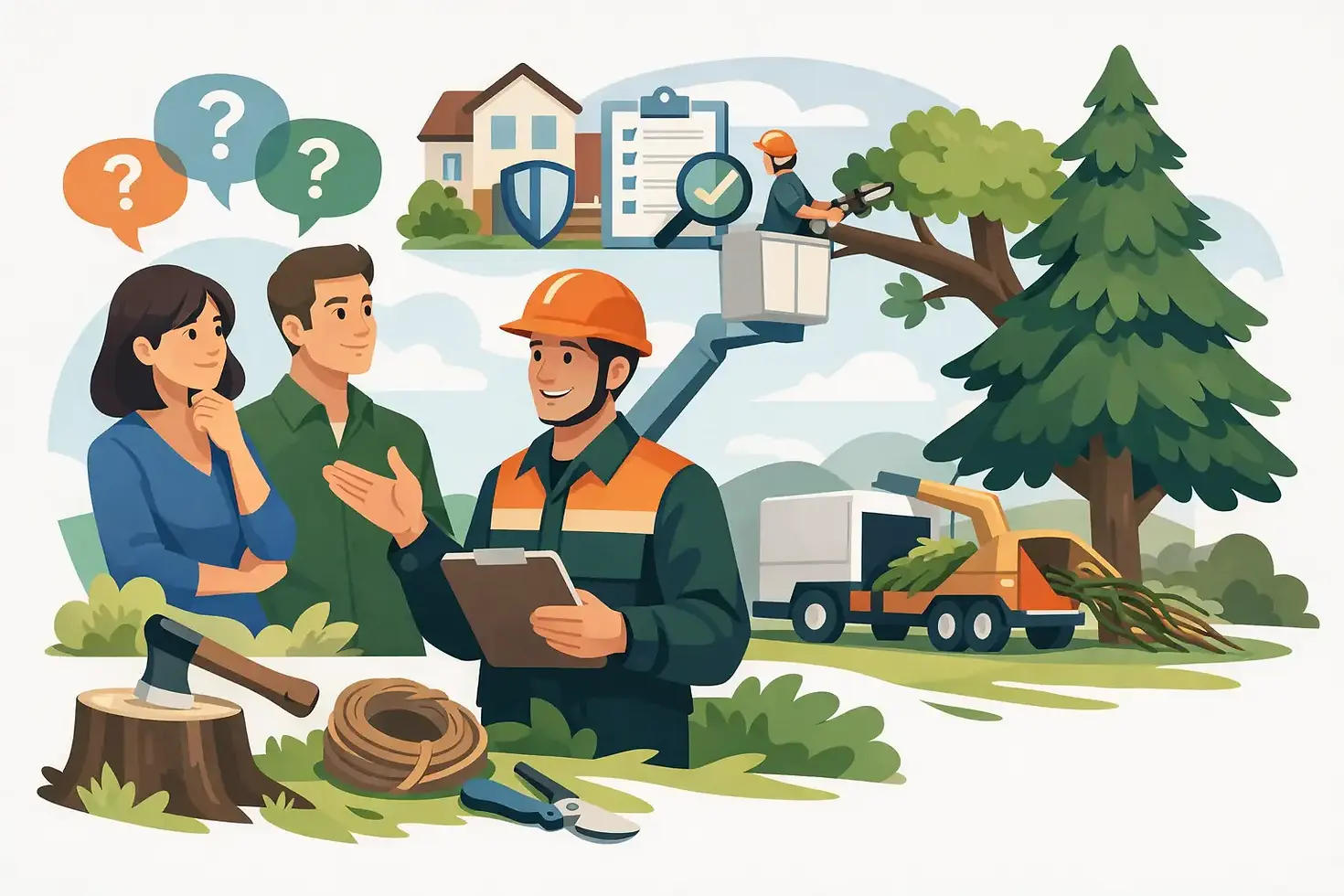
12 Questions to Ask a Tree Service Before Hiring
A low branch over the driveway, a tree leaning after a storm, or a canopy that has grown too thick can turn a simple yard concern into a costly decision. The right questions to ask a tree service help you separate thoughtful tree care from a quick cutting job. A good crew should be able to explain what they recommend, why the work is needed, what it will cost, and how they will leave your property when the job is done.
Tree work is not just about making a yard look tidier. Trees respond to improper cuts, damaged limbs can create real hazards, and a removal or large pruning job affects your lawn, landscaping, fences, and nearby structures. Before you agree to a quote, take time to have a clear conversation.
Questions to Ask a Tree Service About Experience and Care
1. What do you recommend, and why?
Start with the reason behind the proposed work. Ask whether the goal is safety, clearance, storm preparation, tree health, appearance, or removal. A knowledgeable provider should point out specific concerns, such as deadwood, crossing branches, poor limb attachments, decay, or limbs rubbing a roof.
Be cautious if the answer is simply that the tree needs to be “cut back” without a clear explanation. Trees do not benefit from heavy cutting just because they are large. In many cases, selective pruning can reduce risk and improve shape while preserving the living canopy the tree needs.
2. How much can be safely pruned?
This is one of the most valuable questions homeowners can ask. The answer depends on the species, the tree’s age, its current health, the season, and how much foliage has already been removed in recent years. There is no one-size-fits-all number.
Ask the crew to explain which limbs they plan to remove or reduce. Proper pruning focuses on targeted cuts, not stripping out the center of a tree or cutting every branch to the same height. Excessive thinning, topping, and drastic reduction cuts can stress a tree, encourage weak regrowth, and leave it more vulnerable to pests, sun damage, or breakage later.
3. Do you see signs of disease, decay, or structural weakness?
A tree can look green and still have a serious issue. Ask whether the provider sees mushrooms near the base, cavities, cracked unions, hollow areas, peeling bark, dead sections in the canopy, or soil changes around the roots. These signs do not always mean a tree must come down, but they deserve a careful assessment.
A trustworthy company will be candid about uncertainty. Some conditions can be managed with pruning and monitoring. Others require removal because the risk is too high. The important part is receiving a clear explanation instead of being pressured into work you do not understand.
4. Are you recommending removal because it is necessary?
Removal is sometimes the safest choice, especially when a tree is dead, severely damaged, declining beyond recovery, or positioned where failure could harm people or property. But removal should not be the automatic answer for every overgrown or imperfect tree.
Ask what alternatives exist. Could selective pruning, cabling, monitoring, or shrub clearance address the concern? If removal is the right call, ask what makes it necessary now and whether the stump, surface roots, or nearby plants need special attention.
Questions to Ask About Safety and Protection
5. How will you protect my home, lawn, and landscaping?
Tree crews work around roofs, windows, gates, garden beds, patios, power lines, and vehicles. Ask how the team plans to access the tree and control falling limbs. The approach may include roping, controlled lowering, sectional removal, protective mats, or carefully planned drop zones.
The answer should match the conditions in your yard. A small open backyard calls for different methods than a tight side yard with a fence, pool equipment, and flower beds. Let the estimator know about sprinklers, underground utilities, fragile hardscaping, septic systems, and any area you want the crew to avoid.
6. Are you insured for this kind of work?
Ask directly about liability coverage and workers’ compensation. Tree work involves elevated cutting, heavy material, equipment, and unpredictable weather, so this is not a detail to skip. A professional company should be prepared to discuss its coverage and provide the information you need to feel comfortable.
Price matters, but an unusually low quote can be expensive if the crew is not properly equipped or insured. You are hiring someone to work close to one of your biggest investments - your home.
7. What happens if weather changes or conditions become unsafe?
Wind, rain, lightning, saturated soil, and unexpected decay inside a limb can change a plan quickly. Ask how the company handles delays and whether it will stop work if conditions are unsafe. The right answer is not a promise to finish no matter what. It is a commitment to make safe decisions and communicate clearly if the schedule needs to change.
Questions to Ask About the Estimate
8. Is the estimate detailed, and what is included?
A clear estimate protects both the homeowner and the service provider. It should describe the trees or shrubs involved, the general scope of pruning or removal, and whether hauling, cleanup, and disposal are included. If stump work is requested, make sure it is specifically listed because stump grinding and full root removal are different services.
Ask whether there could be additional charges. Sometimes a job changes after hidden damage, inaccessible equipment areas, or unexpected obstacles are found. That does not automatically mean the company is being unfair. What matters is that the crew explains the issue before expanding the work whenever possible.
9. Will you match the work scope when comparing quotes?
Comparing bids is smart, but make sure you are comparing the same job. One quote may include complete debris hauling and cleanup while another leaves brush at the curb. One may involve careful crown reduction while another proposes a cheaper, heavier cut that could harm the tree.
Rather than choosing on price alone, ask each company to spell out what it will do. Fair pricing should come with a defined scope, not vague promises or surprise add-ons.
10. Are financing options available for larger work?
A large removal or urgent safety concern may not arrive at a convenient time. If the work is necessary but the cost is difficult to handle all at once, ask whether financing is available. Knowing your options can help you address a real risk sooner instead of postponing it until damage occurs.
Questions to Ask About Cleanup and Communication
11. Who handles debris, and what will the yard look like afterward?
Do not assume cleanup means the same thing to every company. Ask whether the crew will chip brush, haul logs, rake smaller debris, blow off hard surfaces, and remove sawdust from the work area. If you want firewood left behind, say so before work begins and discuss where it should be placed.
A professional job does leave some normal signs of work, especially after a large removal. Still, your property should not be left with scattered branches, damaged gates, or piles of debris you did not agree to keep. Respect for the yard is part of the service.
12. Who will I communicate with before and during the job?
Ask who your point of contact will be, when the crew expects to arrive, and how schedule changes will be communicated. It also helps to confirm whether you need to be home, where the crew can park, and how pets should be secured.
Clear communication matters just as much when you have a small request. Maybe you need a branch saved for a swing, a gate kept closed, or access maintained for a neighbor. A customer-first crew listens to those details and sets realistic expectations.
A Better Conversation Leads to Better Tree Care
The best tree service conversation should leave you feeling informed, not rushed. You should understand the plan for your trees, the care being taken around your property, the price you are approving, and what cleanup will look like afterward.
At J&J Arboriculture, that is the standard we work toward: practical advice, careful pruning that respects tree health, honest pricing, and a clean property when the crew is finished. When a tree concern is on your mind, ask the questions that help you hire with confidence - then choose the team that answers them plainly and treats your yard like it matters.


Comments